Miyawaki Forests in India: A Practical Guide to Designing, Planting & Maintaining Urban Forests
Urban India is growing rapidly, but green spaces are often shrinking under the pressure of roads, buildings, infrastructure and expanding cities. In this changing landscape, Miyawaki forests are gaining attention as a practical approach to creating dense, diverse and nature-oriented green spaces within relatively small areas. From institutional campuses and residential communities to industrial properties, schools, parks and urban development projects, the Miyawaki approach can help transform underutilized land into vibrant pockets of vegetation. However, creating a successful Miyawaki forest is not simply a matter of planting trees very close together. The real success of the method depends on careful site assessment, appropriate native species selection, soil preparation, planting design, establishment care and long-term ecological management.
What Is a Miyawaki Forest?
The Miyawaki method was developed by Japanese botanist Akira Miyawaki and is based on the principles of potential natural vegetation. Instead of creating a plantation dominated by one or a few tree species, the method attempts to establish a multilayered plant community containing species representing different vegetation layers. A typical Miyawaki plantation may include ground-cover plants, shrubs, sub-canopy trees and canopy trees, creating a dense structure that resembles a naturally developing forest ecosystem. The objective is not simply to produce a large number of trees, but to establish a diverse and structurally complex vegetation community that can develop into a functional urban green space.
Why Are Miyawaki Forests Becoming Popular in India?
Indian cities face several environmental challenges, including increasing built-up areas, loss of vegetation, heat accumulation, soil degradation, biodiversity decline and reduced ecological connectivity. Small urban forest projects can provide opportunities to reintroduce vegetation into spaces that may otherwise remain unused or degraded. Depending on the site and design, such plantations can contribute to urban biodiversity, shade, habitat creation, dust interception, visual screening, soil improvement and a stronger connection between people and nature. Their value is therefore broader than simply counting the number of trees planted.
Can the Miyawaki Method Be Used Anywhere in India?
The basic ecological principles of the Miyawaki approach can be adapted to Indian conditions, but there should not be a single standard plant list for the entire country. India contains a remarkable range of climates, soils and natural vegetation types. A species suitable for Bengaluru may not necessarily be appropriate for a dry landscape in Rajasthan, a humid site in Kerala or a saline coastal location. Therefore, successful Miyawaki projects should begin with understanding the local ecological context.
For an Indian project, factors such as rainfall, temperature, soil type, drainage, groundwater availability, existing vegetation, sunlight, land-use history and surrounding vegetation should influence species selection. Whenever possible, the planting palette should emphasize regionally appropriate native species rather than simply selecting fast-growing trees because they grow quickly.
Step 1: Start With a Proper Site Assessment
A successful Miyawaki forest begins before the first plant reaches the site. The land should be assessed for soil condition, sunlight availability, drainage, slope, existing vegetation, water availability, accessibility and surrounding land use. Soil testing can provide useful information about pH, organic matter, electrical conductivity and nutrient status. Compacted construction soil may require substantial preparation before it can support healthy plant growth.
The site assessment should also identify existing trees and valuable vegetation. Mature trees should generally be protected rather than removed simply to create a new plantation. Existing vegetation can become an important component of the ecological design and can provide shade, habitat and structural diversity from the beginning.
Step 2: Understand the Native Vegetation
One of the most important steps in designing an Indian Miyawaki forest is understanding what naturally grows in the region. Historical vegetation records, nearby natural habitats, forest vegetation, botanical references and local ecological knowledge can help identify appropriate species.
Instead of asking only, “Which trees grow fast?”, the better question is, “Which species naturally belong to this landscape and can perform together under these site conditions?”
A diverse planting palette may include canopy-forming trees, sub-canopy species, shrubs and ground-layer plants. The exact composition should be customized according to the ecological region and project objectives.
Step 3: Prepare the Soil
Soil preparation is one of the most critical components of a Miyawaki project. Urban sites frequently contain compacted, nutrient-poor or disturbed soil. Simply digging small planting pits and inserting seedlings may not provide the conditions required for vigorous establishment.
Depending on soil-test results and site conditions, soil preparation may involve loosening compacted soil, improving organic matter, incorporating suitable compost or other approved amendments, improving drainage and creating an appropriate planting medium.
However, soil amendments should not be applied blindly. Excessive use of fertilizers or organic materials can create nutrient imbalances and may not replicate healthy forest-soil conditions. The objective should be to create a biologically active and well-structured root environment rather than simply producing rapid initial growth.
Step 4: Design the Forest in Multiple Layers
A forest is more than a collection of trees. It is a vertically structured ecosystem.
A well-designed Miyawaki plantation can include different vegetation layers, such as ground layer, shrub layer, sub-canopy layer and canopy layer. Combining species with different growth forms allows the planting to develop greater structural diversity as it matures.
The planting design should also consider mature plant size, crown architecture, root characteristics, light requirements, seasonal behaviour and compatibility between species. A dense planting should not become an overcrowded collection of unsuitable plants competing for the same resources.
Step 5: Plant at Appropriate Density
Dense planting is one of the characteristics associated with the Miyawaki method. However, density should be determined according to species characteristics, site conditions and project objectives rather than following a single number for every project.
Young plants require sufficient space for root development while the overall plantation should have enough density to encourage rapid occupation of the available space. A professional design should therefore balance initial planting density with expected plant growth and long-term ecological development.
This is particularly important in India because species growth rates can vary significantly between climates and soils.
Step 6: Choose Plants for Ecological Function, Not Just Appearance
A common mistake in urban landscaping is selecting plants primarily because they are attractive or readily available in nurseries. A Miyawaki forest requires a different mindset.
Plants should be selected for their ecological suitability, local adaptation, structural role, biodiversity value and long-term performance. Fruit-bearing species can provide resources for birds and other wildlife. Flowering species can support pollinators. Dense shrubs can provide shelter, while larger trees can eventually contribute to canopy formation.
This approach transforms the plantation from a decorative green space into a more functional urban habitat.
Step 7: Mulching and Water Management
Water is especially important during the establishment phase. Even species adapted to local conditions need adequate moisture while their root systems are developing.
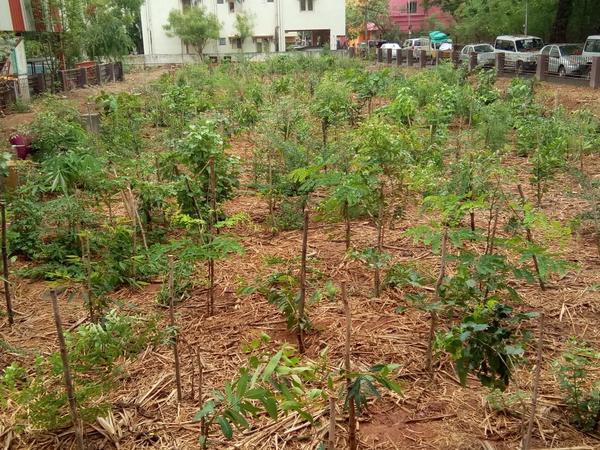
Mulching can help reduce evaporation, moderate soil temperature and protect the soil surface. Depending on the location and project scale, irrigation systems such as drip irrigation or other efficient watering systems may be incorporated during the establishment period.
The long-term objective should not necessarily be permanent intensive irrigation. As the vegetation becomes established, the management strategy can gradually focus on encouraging plants to function under the prevailing local conditions, subject to species and site requirements.
Step 8: The First Few Years Are Critical
One of the biggest misconceptions about Miyawaki forests is that they become self-sustaining immediately after planting.
The establishment period requires active management. Weeding, irrigation, mulching, plant replacement, pest monitoring, staking where necessary and periodic growth assessment may be required, particularly during the early stages.
Maintenance requirements will vary according to rainfall, soil, species composition and site conditions. A professionally planned Miyawaki project should therefore include a clear maintenance strategy rather than treating maintenance as an afterthought.
How Long Does a Miyawaki Forest Take to Develop?
There is no universal timeline for a Miyawaki forest. Growth depends on climate, soil quality, species selection, water availability, planting density and maintenance.
The plantation may appear significantly denser within the first few years, but ecological maturity is a much longer process. A young plantation should not be judged only by how quickly it becomes visually dense. The development of canopy structure, understory vegetation, soil biology, wildlife interactions and ecological functions should also be considered.
Therefore, claims that every Miyawaki forest will become a “mature forest” within a fixed number of years should be treated cautiously.
Common Mistakes to Avoid
A Miyawaki forest can fail when the method is treated as a simple tree-planting formula. Common problems include using inappropriate species, planting only fast-growing trees, ignoring soil conditions, overusing fertilizers, inadequate irrigation during establishment, poor drainage, neglecting maintenance and selecting species that are unsuitable for the local climate.
Another common mistake is focusing heavily on the number of saplings planted rather than the quality of the ecological design. Ten thousand unsuitable plants do not necessarily create a better forest than a smaller, scientifically planned plantation.
Miyawaki Forests for Indian Urban Projects
The Miyawaki approach can potentially be adapted to a wide range of projects, including schools, universities, residential communities, corporate campuses, industrial estates, hospitals, public institutions, parks, temple premises and degraded urban land.
For commercial and institutional developments, these plantations can also become part of a broader green infrastructure strategy, complementing rain gardens, bioswales, native landscapes, biodiversity gardens, water-sensitive design and other nature-based solutions.
The strongest projects are those where the forest is integrated into the overall site design rather than treated as an isolated plantation.
Designing a Miyawaki Forest: A Professional Approach
At SR Greenscapes, we believe that a Miyawaki forest should begin with science, not simply a planting target. Every site has its own ecological conditions, and the planting strategy should respond to those conditions.
Our approach can include site assessment, soil evaluation, ecological and native species selection, planting-layer planning, soil preparation, plantation execution, irrigation planning and establishment maintenance. The objective is to create green spaces that are not only visually attractive but also ecologically meaningful and appropriate for the site.
A successful urban forest is not created by planting more trees alone. It is created by putting the right plants, in the right place, in the right soil, with the right management strategy.
The Future of Miyawaki Forests in India
As Indian cities search for practical ways to increase urban greenery and biodiversity, compact forest plantations can become an important component of sustainable landscape planning. But the future of Miyawaki forests should move beyond the idea of simply creating “dense forests quickly.”
The greater opportunity lies in developing site-specific, native, biodiversity-oriented and scientifically managed urban forests that complement broader green infrastructure and nature-based solutions.
The question is no longer simply, “How many trees can we plant?”
It is:
“What kind of living ecosystem can we create?”
When planned carefully, even a relatively small urban site can become a valuable green asset—providing habitat, shade, ecological connectivity and a stronger connection between people and nature.
Ready to Plan a Miyawaki Forest?
If you are planning a Miyawaki forest, native plantation, biodiversity landscape or urban green project for a school, residential community, institution, corporate campus, industrial property or public space, professional planning can make a significant difference.
SR Greenscapes Pvt. Ltd. brings together landscape design, horticulture, plant selection and sustainable landscape management to develop site-specific green solutions for Indian conditions.
Based in Bengaluru | Pan-India Project Execution
🌿 Science-Driven Sustainable Landscapes
🌱 Landscape Design & Execution | Miyawaki Forests | Native Plantations | Biodiversity Landscapes | Horticulture Consultancy | Maintenance
Let’s build future-ready landscapes.